


Take a Guess: How Many Professionals and Data Fields Are in a Typical Mortgage Process?

The Hidden Army Behind Your Salem Home Loan
If you have ever purchased a home in Salem, OR, you probably remember signing what felt like a mountain of paperwork. But have you ever stopped to wonder exactly how many professionals are working behind the scenes, or just how many individual data fields must be completed from the initial mortgage application to closing day? The numbers might shock you.
At Mortgage Marketplace, we guide Willamette Valley homebuyers through this complex maze every single day. Let’s pull back the curtain on the typical mortgage process to see who is involved.
Here is a quick look at the army of professionals required for a standard real estate transaction:
- Mortgage Broker / Loan Officer: Your primary guide (like Mike Gillett) who structures the loan and finds the best rates.
- Loan Processor: The detail-oriented expert who gathers, organizes, and verifies your documentation.
- Underwriter: The lender’s decision-maker who analyzes risk, reviews the data, and ensures compliance with mortgage guidelines.
- Appraiser: The local Salem real estate expert who physically inspects the property to determine its fair market value.
- Title & Escrow Officers: The neutral third parties who research property history to ensure the title is clear, and who handle the secure transfer of closing funds.
- Home Inspectors & Insurance Agents: Professionals who protect the property’s physical condition and financial integrity.
That is at least seven to eight distinct professionals touching your file before you ever get the keys!
Counting the Data Fields: A Mountain of Mortgage Paperwork
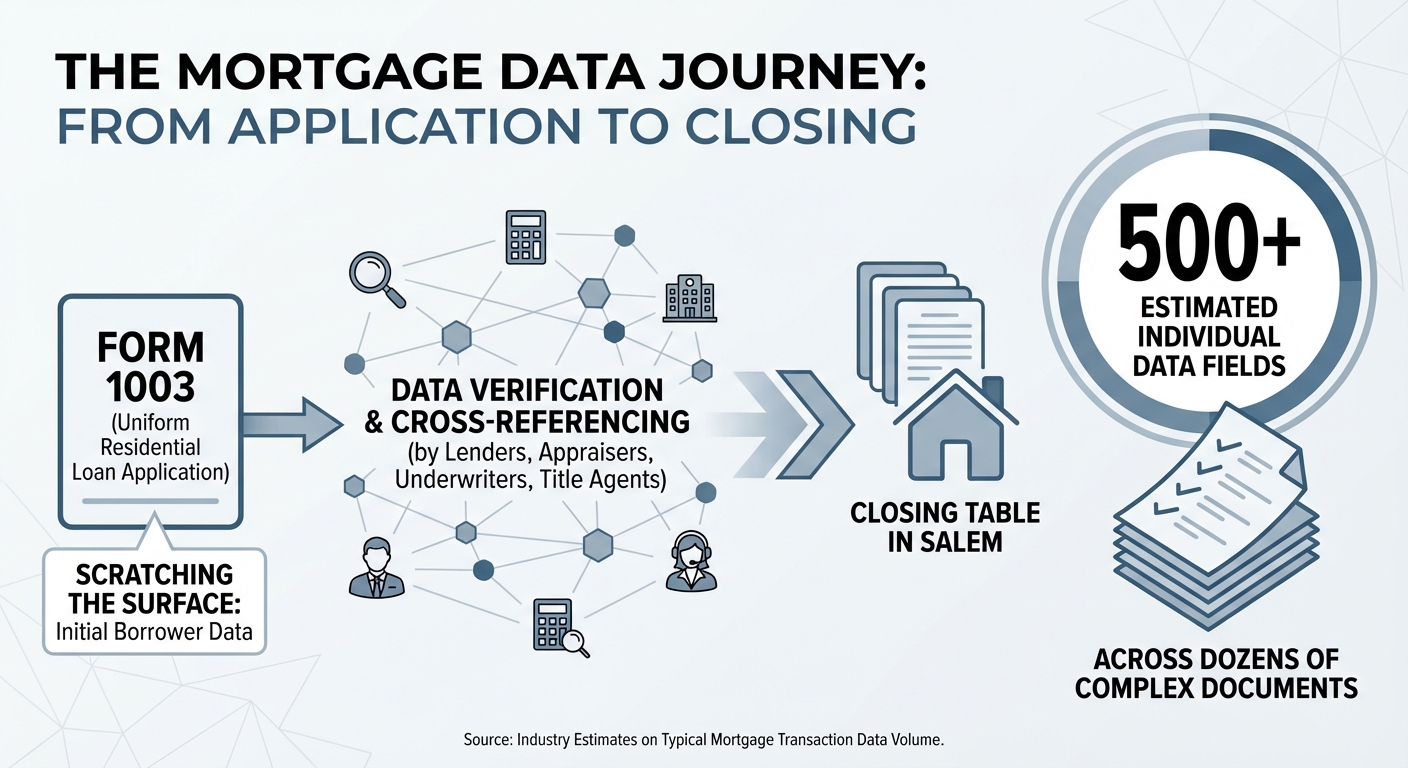
Now, let’s talk about the data itself. When you fill out a standard Uniform Residential Loan Application (also known as a Form 1003), you are just scratching the surface. By the time you reach the closing table in Salem, hundreds of fields have been populated, verified, and cross-referenced by the various professionals mentioned above.
Industry experts estimate that a typical mortgage transaction requires the completion of over 500 individual data fields across dozens of complex documents. This includes everything from your basic identifying information and two-year employment history to complex debt-to-income ratios, property tax assessments, and title recording numbers.
Why is there so much paperwork? Because every single piece of data protects you, the lender, and the integrity of the housing market. Accuracy is absolutely paramount. A single misplaced digit can cause delays, which is why having an experienced, detail-oriented local broker at Mortgage Marketplace is crucial to keep the process running smoothly.
| Mortgage Document / Stage | Primary Professional Responsible | Estimated Data Fields |
|---|---|---|
| Uniform Residential Loan Application (1003) | Borrower / Mortgage Broker | 100+ |
| Loan Estimate (LE) | Loan Officer / Processor | 75+ |
| Appraisal Report (URAR 1004) | Licensed Appraiser | 150+ |
| Title Commitment & Report | Title Officer | 80+ |
| Closing Disclosure (CD) | Escrow Officer / Underwriter | 100+ |
| Total Estimated Fields | All Parties Combined | 505+ Fields |
Streamlining Your Mortgage Experience in Salem, OR
While the sheer volume of professionals and data fields seems overwhelming, the good news is that you do not have to manage it alone. As an independent mortgage broker in Salem, OR, Mike Gillett and the team at Mortgage Marketplace act as the project managers for your home loan.
We coordinate directly with the processors, underwriters, appraisers, and escrow officers so you can focus on the exciting part: packing your boxes and planning your move. By leveraging modern lending technology and deep local expertise, we ensure those 500+ data fields are filled out accurately and efficiently, getting you to the closing table faster and with far less stress.
Q1: How long does the typical mortgage process take in Salem, OR?
On average, the mortgage process takes 30 to 45 days from the initial application to closing day, though this timeline can vary based on the specific loan type, property conditions, and market volume.
Q2: Why are there so many data fields on a mortgage application?
The extensive data collection is required by federal regulations and lending institutions to accurately assess borrower risk, verify identity, prevent fraud, and ensure the property meets strict lending standards.
Q3: Who is the most important professional in the mortgage process?
While every role is crucial to closing the loan, your Mortgage Broker or Loan Officer is your primary advocate. They coordinate all the other professionals (processors, underwriters, appraisers) to ensure a smooth and timely closing.
Q4: Can errors in these data fields delay my closing?
Absolutely. Even minor discrepancies in data fields—such as variations in name spelling, previous addresses, or slight differences in income figures—can trigger underwriting conditions and delay your closing date.
Q5: How can I make the mortgage paperwork process easier?
The best way to simplify the process is to gather all your financial documents early (W-2s, bank statements, pay stubs) and work with an experienced local broker like Mortgage Marketplace who utilizes streamlined, secure digital application portals.